
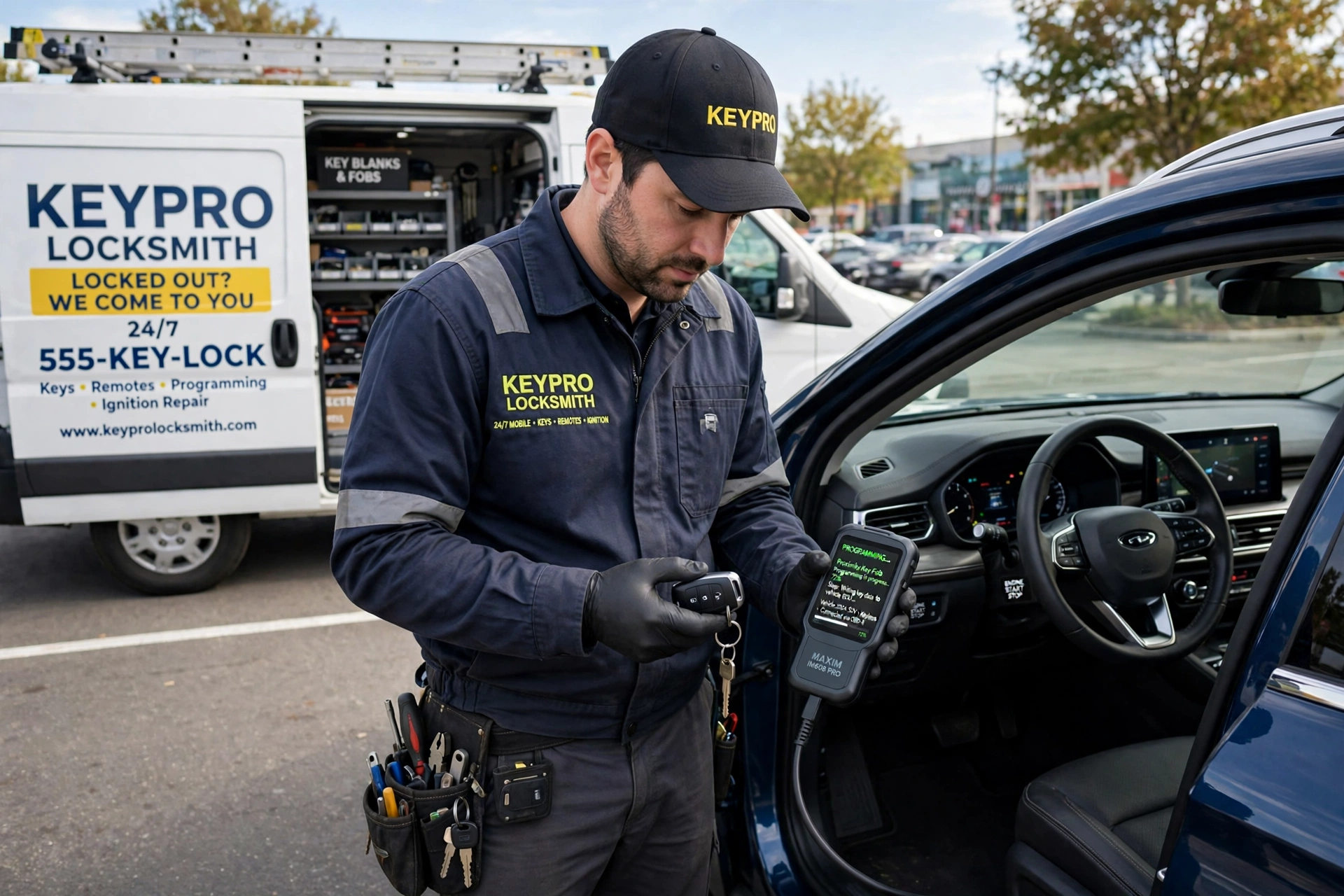

Your key turns, the dashboard lights up, the engine may even crank — but the car will not start. In many modern vehicles that is not a starter or battery problem. It is the immobilizer doing its job, or failing to recognize your key. The immobilizer is the electronic anti-theft system that decides, in a fraction of a second, whether the key in the ignition or in your pocket is authorized to start the vehicle.
In Miami, immobilizer faults are one of the most misdiagnosed problems drivers face: batteries, starters and even ECUs get replaced before anyone checks whether the car actually recognizes the key. This guide explains how an immobilizer system works, the most common failures we see in Miami-Dade, and how a mobile automotive locksmith diagnoses the real cause before parts are replaced.
How a car immobilizer system works
Most systems built from the late 1990s onward follow the same basic chain:
- The transponder chip in the key. Inside the head of the key — or inside the smart fob — there is a small chip with a unique electronic code. It has no battery of its own in most blade keys; it is powered by the signal around the ignition.
- The antenna ring (coil) around the ignition. When you insert the key or press the start button, a coil around the lock or reader sends energy to the chip and reads its code.
- The immobilizer unit and the ECU/BCM. The code is checked against the codes stored in the vehicle’s immobilizer module, body control module (BCM) or engine control unit (ECU), depending on the make. Some brands store key data in a dedicated immobilizer box; others in the instrument cluster, the steering lock (ELV) or the electronic ignition switch (EIS) on many European models.
- Authorization to start. If the code matches, the system enables fuel and ignition and the immobilizer light goes out. If it does not match — or the code is never read — starting is blocked, even if the mechanical cut of the key is perfect.
That is why a plain metal copy can turn in the lock and still never start the car: the cut opens the lock, but only the chip convinces the immobilizer.
The most common immobilizer failures
- Damaged or dead transponder chip. A key that was dropped, crushed, opened or exposed to water can lose a working chip. The key looks fine and turns, but the car no longer reads it.
- An unprogrammed or incorrectly programmed key. A new key cut from the internet or a hardware store copy without the chip registered to the car will not start it. The key must be programmed to the specific vehicle.
- Antenna ring failure. The coil around the ignition can fail or lose its connection, so no key — not even the original — is read correctly. The symptom is often intermittent: the car starts sometimes and not others.
- Low voltage and battery problems. A weak car battery or voltage drops during cranking can interrupt the reading of the chip or the communication between modules. Always rule out a healthy battery before condemning a module.
- Module data problems. On some models, key data stored in the immobilizer, BCM, ECU or steering lock can become corrupted or desynchronized — after a flat battery, a jump-start, water intrusion or a failed programming attempt. In those cases the modules themselves may be repairable through data work rather than replacement, but that must be confirmed model by model.
- Aftermarket accessories interfering. Poorly installed remote starters, alarms or bypass modules can imitate or block the immobilizer signal and create no-start faults that come and go.
- Smart key and proximity faults. On keyless models, a weak fob battery, a damaged fob or a fault in the proximity antennas can stop the car from detecting an otherwise correct key — starting with the fob held against the start button is a useful test on many models.
Signs the problem is the immobilizer — not the starter or battery
- The immobilizer/security light stays on, flashes rapidly, or never goes out when you try to start
- The engine cranks normally but never fires, or starts for one second and dies
- One key starts the car and another key — same cut — does not
- The problem began right after a key was copied, a battery went flat, or an accessory was installed
- The car starts intermittently with no clear pattern
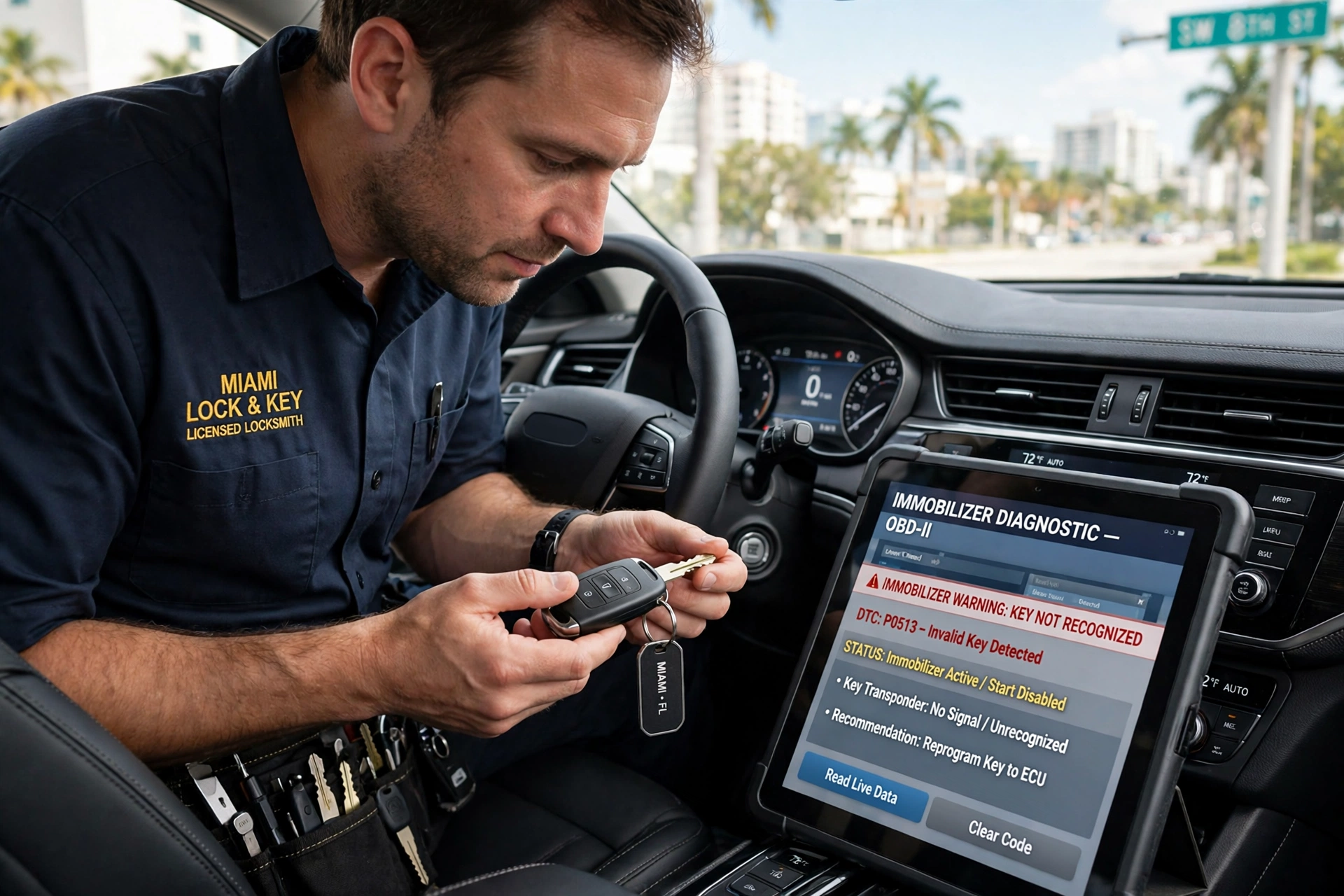
None of these signs alone proves the cause. A correct diagnosis reads the immobilizer and ECU fault data, tests whether the key’s chip is being read, and checks communication between modules before any part is replaced.
How we diagnose an immobilizer fault in Miami
A mobile automotive locksmith works through the chain in order: verify the battery and basic power, test the key’s chip and whether the antenna reads it, scan the immobilizer and engine systems for stored faults, and confirm whether the key is registered in the vehicle’s data. From there the fix may be as simple as programming a correct key, or it may involve module data repair or transfer (ECU, BCM, EIS/ELV) on models where that work is supported. We confirm the exact scope for your make, model and year before starting — immobilizer systems differ too much between brands to promise one procedure for all of them.
What to have ready when you call
- Make, model and year — they decide where the key data lives and which procedure applies
- What the dashboard shows — whether the immobilizer light stays on or flashes, and whether the engine cranks
- Which keys you have — and whether any of them still starts the car
- What changed recently — a new copy, a flat battery, a jump-start, water, or a newly installed alarm or remote starter
- Your location — address or shared pin in Miami-Dade so the mobile unit reaches the car directly
- Proof of ownership — identification and ownership proof are reasonably required before key programming or module work
Service areas
Our mobile units cover Miami, Miami Beach, Doral, Kendall, Coral Gables, Brickell, Downtown, Wynwood, Hialeah, Aventura, Homestead and Miami Springs, and we serve drivers across South Florida.
Frequently asked questions
Can a locksmith fix an immobilizer problem, or is that dealer-only work?
In many cases a professional automotive locksmith can diagnose and resolve it — key programming, chip replacement and, on supported models, module data work are core locksmith services. Some models and faults do require dealer-level access; we tell you that up front if yours is one of them.
My key turns and the engine cranks, but the car won’t start. Is it the immobilizer?
It is a strong possibility, especially if the immobilizer light stays on or flashes. It is not a certainty — fuel, ignition and electrical faults can look similar — which is why the system is scanned before anything is replaced.
I made a copy of my key and the copy won’t start the car. Why?
Almost always because the copy has no chip, or its chip was never programmed to your car. The cut alone is not enough on any immobilizer-equipped vehicle.
Can the immobilizer be bypassed or removed?
We do not bypass or disable factory anti-theft systems. The correct fix is to restore the system so an authorized key starts the car — that keeps the vehicle legal, insurable and protected.
How long does diagnosis take?
Reading the key, the antenna and the fault memory is usually the fast part. Programming or module data work takes longer and depends on the model. We confirm scope, time and price before the work begins.
Get a real diagnosis before you replace parts
If your car will not start and the immobilizer light is part of the story, send us the make, model and year and describe what the dashboard shows. Matrix Locksmith Pro — car immobilizer diagnosis, key programming and module data work where your car is, anywhere in Miami-Dade.