

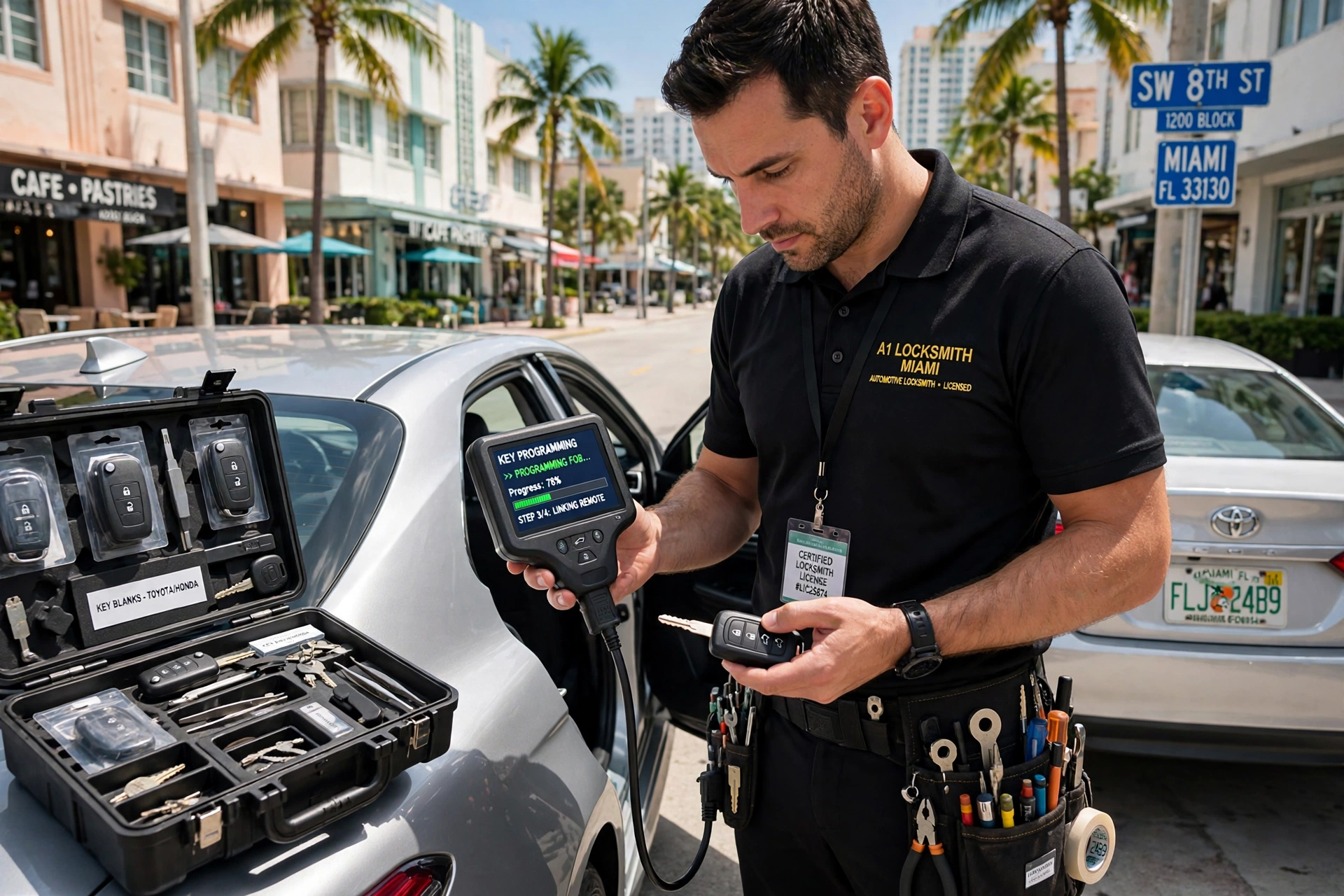
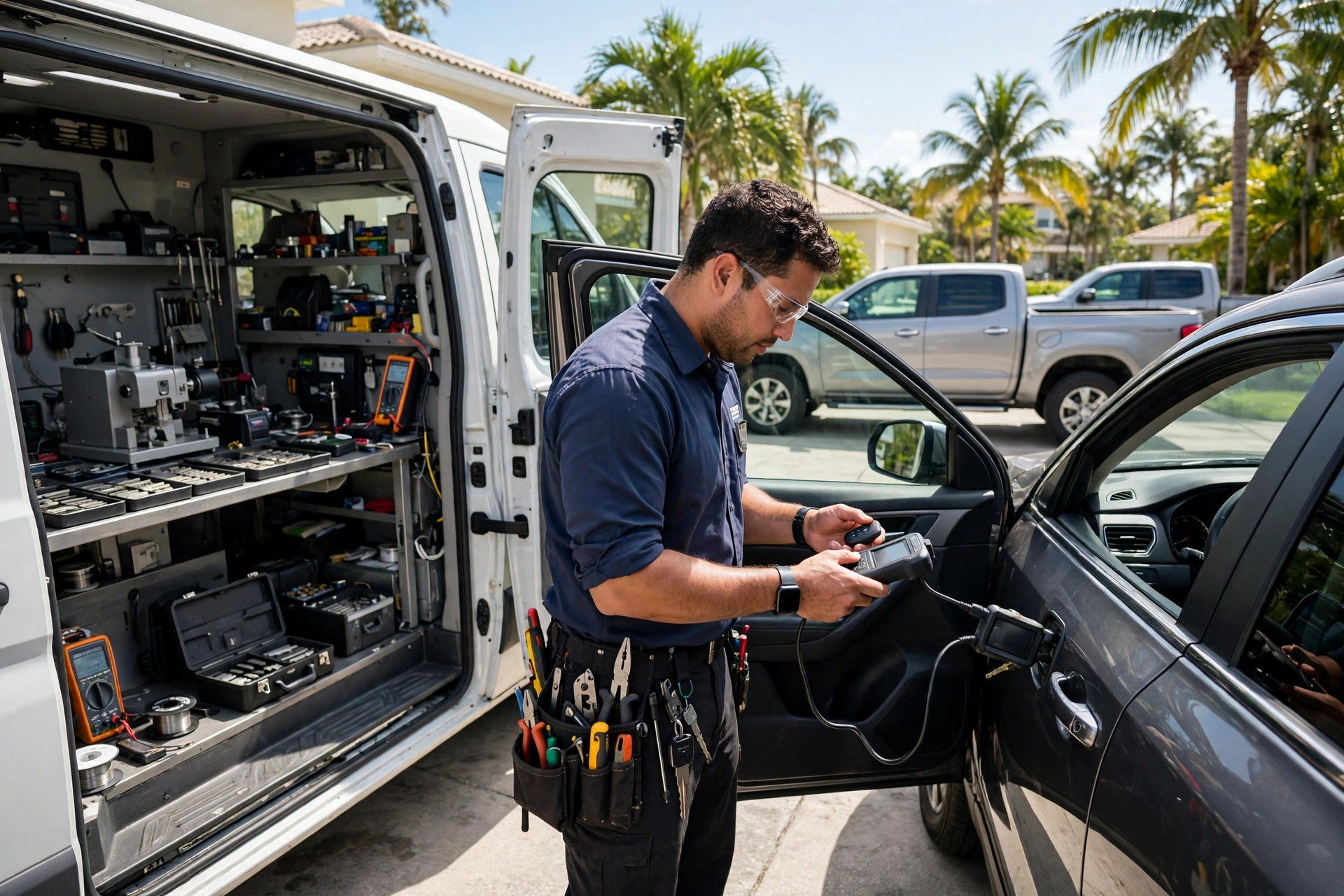
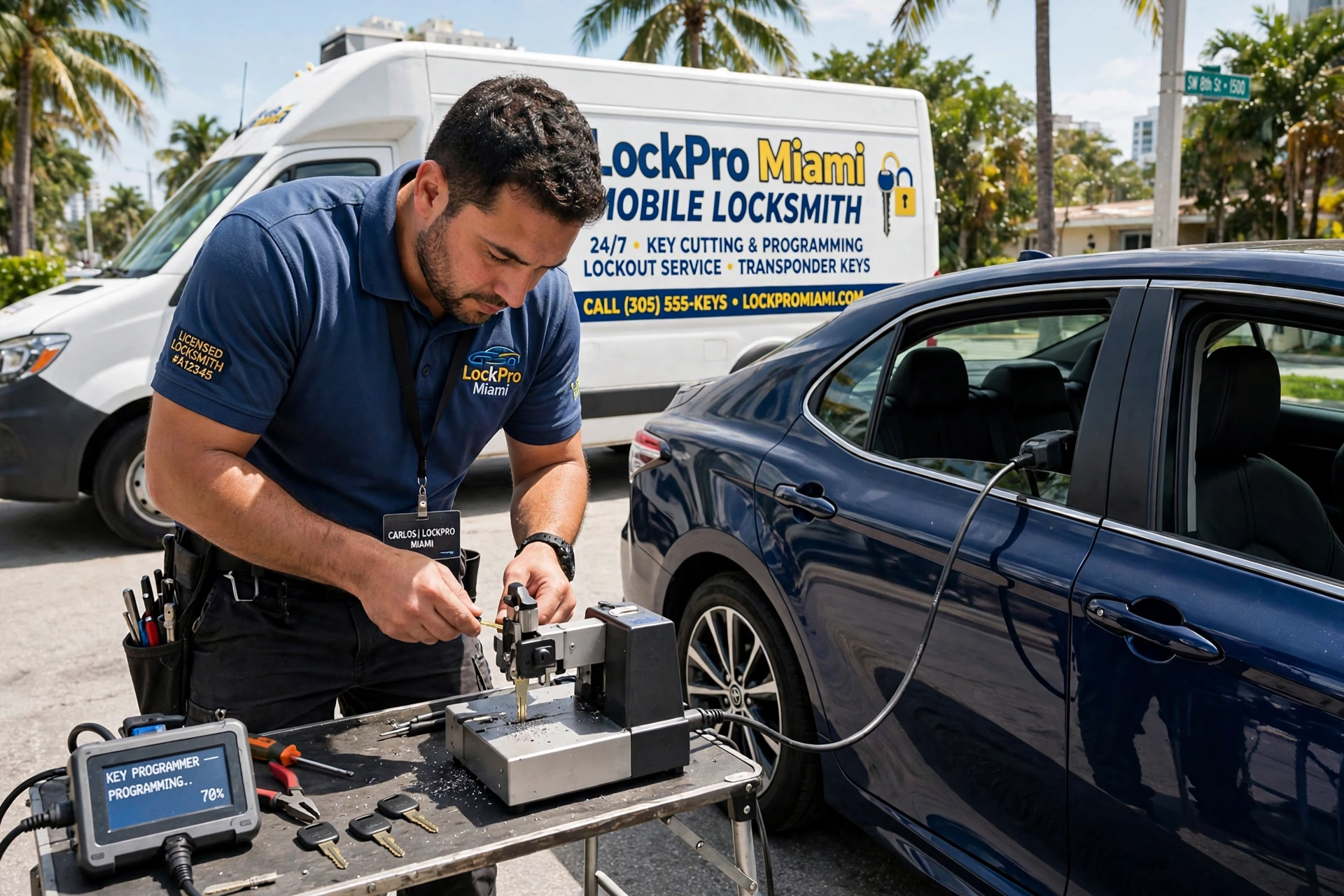
Most drivers in Miami drive around with exactly one key — and don’t think about it until that key is lost, breaks or stops working. That is the exact moment a simple duplication turns into an all-keys-lost job: more steps, more time and more proof required, with the car unusable in the meantime. A spare car key made while you still have a working key is one of the simplest preventive jobs in automotive locksmithing.
This guide explains the difference between duplicating from a working key and recovering from all keys lost, which key types can be duplicated, what the process involves, and how to store and use a spare so it actually protects you.
Duplicate from a working key vs. all keys lost: the real difference
- With a working key, the locksmith can read the key’s cuts and its transponder chip data, cut a new blade to the same pattern and program the new chip so the car recognizes it. The working key proves the pattern and helps confirm the correct chip type.
- With all keys lost, there is nothing to copy. The key has to be generated from the vehicle’s lock or its code, and the immobilizer has to be accessed and programmed without a recognized key present. On many models that means additional security procedures and verification.
- Time and disruption. A duplication is a planned, scheduled job at your home or office. An all-keys-lost recovery is an emergency, often at the worst place and time — a parking garage at night, an airport lot, a beach lot in the Miami heat.
The work is the same trade in both cases, but the starting point changes everything. Duplicating while you have a key is preventive; recovering after losing the only one is corrective.
Which car keys can be duplicated
- Transponder (chip) keys. The blade is cut and the chip is cloned or programmed to the car. This covers most cars from the late 1990s onward.
- Remote head keys. A key with lock/unlock buttons built into the head: blade, chip and remote functions are all set up and tested.
- Smart keys and proximity fobs. Push-button start fobs are programmed to the vehicle so the car detects them for entry and starting. The emergency blade inside the fob is also cut, so a dead fob battery does not lock you out.
- High-security / laser-cut keys. Side-milled blades common on European and newer models need a laser cutter; they duplicate the same way, with the correct equipment.
- Motorcycle keys. The same logic applies to bikes: duplicating a working transponder motorcycle key is far simpler than an all-keys-lost recovery on the immobilizer.
If you are not sure which type your car uses, the make, model and year — plus a photo of your current key — are enough to confirm it before anyone comes out.
What a duplication appointment looks like
- Confirmation first. Make, model, year and key type are confirmed, along with the price, before the work begins.
- Cutting. The new blade is cut to the original pattern with an electronic cutter — not traced freehand — so it turns smoothly in the door and the ignition (or works as the emergency blade in a smart fob).
- Programming. The transponder chip or smart fob is programmed to the car and, where the model requires it, the remote functions are paired at the same time.
- Testing. The new key is tested the way you will use it: unlock, lock, start the engine, and on smart keys, start with the fob inside the car as normal. A spare that has not been tested starting the car is not finished.
- Old keys keep working. Duplication adds a key; it does not remove your existing one, unless you ask for lost keys to be deleted from the car’s memory for security.
Why one key is a bigger risk in Miami
- Heat, beach and water. Keys are lost at the beach, dropped in marinas and damaged by heat and humidity more often in South Florida than almost anywhere else.
- Valet and parking garages. Downtown, Brickell and Miami Beach parking means your only key changes hands often — every handoff is a chance of loss or damage.
- Two drivers, one key. Households sharing one car and one key end up locked out or stranded far more often than they expect.
- A worn only key. If the one key you have is already cracked, bent or with a failing fob casing, its failure is a matter of time — duplicate it while it still works well enough to copy.
How to store and manage your spare
- Keep the spare at home, not in the car. A spare inside the vehicle does not help when you are locked out of that vehicle.
- Label it discreetly. Mark which car it belongs to without writing the plate or address on the tag.
- Tell the other driver where it is. A spare nobody can find is the same as no spare.
- Test it once in a while. Start the car with the spare every few months so a dead fob battery or a problem is found at home, not on the road.
- After a loss, consider deleting the lost key. If a key is lost somewhere it could be found and identified, ask about removing it from the car’s memory when the new key is programmed.
What to have ready when you call
- Make, model and year — they decide the key type, chip and programming method
- Your current working key — duplication starts from it
- A photo of the key — helps confirm blade type and fob model in advance
- Whether you also need lost keys deleted — for security after a loss
- Your location — home, office or wherever the car is in Miami-Dade; duplication is done on site by a mobile unit
- Proof of ownership — identification and ownership proof are reasonably required before key programming
Service areas
Our mobile units cover Miami, Miami Beach, Doral, Kendall, Coral Gables, Brickell, Downtown, Wynwood, Hialeah, Aventura, Homestead and Miami Springs, and we serve drivers across South Florida.
Frequently asked questions
Can any car key be duplicated while I still have one working?
In most cases, yes — transponder keys, remote head keys, laser-cut keys and smart fobs can all be duplicated from a working key for most makes and models. Send the make, model, year and a photo of your key and we confirm the exact type before the appointment.
Is duplicating a smart key the same as duplicating a metal key?
No. A metal emergency blade is only cut. A smart key also has to be programmed so the car recognizes it for keyless entry and push-button start, and its remote functions are tested. Both parts — blade and programming — are done in the same visit.
Will making a spare affect my existing key?
No. Duplication adds a new recognized key; your current key keeps working exactly as before. The only exception is when you ask us to delete a lost key from the car’s memory for security, which does not affect the keys you still have.
What if I already lost my only key?
Then it is an all-keys-lost job, which is also a service we perform — the key is generated for the vehicle and programmed without a working key. It simply takes more steps than a duplication, which is why making the spare beforehand is the smarter order.
How long does a duplication take?
It depends on the model and key type — cutting is quick; programming and testing take the rest of the time. We confirm scope, time and price before the work begins.
One key is a risk you can fix today
If you are driving in Miami with a single key, duplicating it while it still works is the cheapest insurance against an all-keys-lost emergency. Send us the make, model and year and a photo of your key. Matrix Locksmith Pro — spare transponder and smart keys cut and programmed where your car is, anywhere in Miami-Dade.