
You put the key in, turn — and nothing. Or the key turns halfway and sticks. Or it only starts if you jiggle the key at exactly the right angle. Ignition problems rarely fix themselves: a worn ignition cylinder gets worse with every turn, until one day the key will not turn at all and the car is stuck wherever it sits in Miami.
This guide explains how a car ignition is built, the signs that the cylinder or the switch is failing, the difference between repairing and replacing it, and what the work means for your keys and the immobilizer.
How a car ignition is built
On a traditional keyed ignition there are two parts that people often confuse:
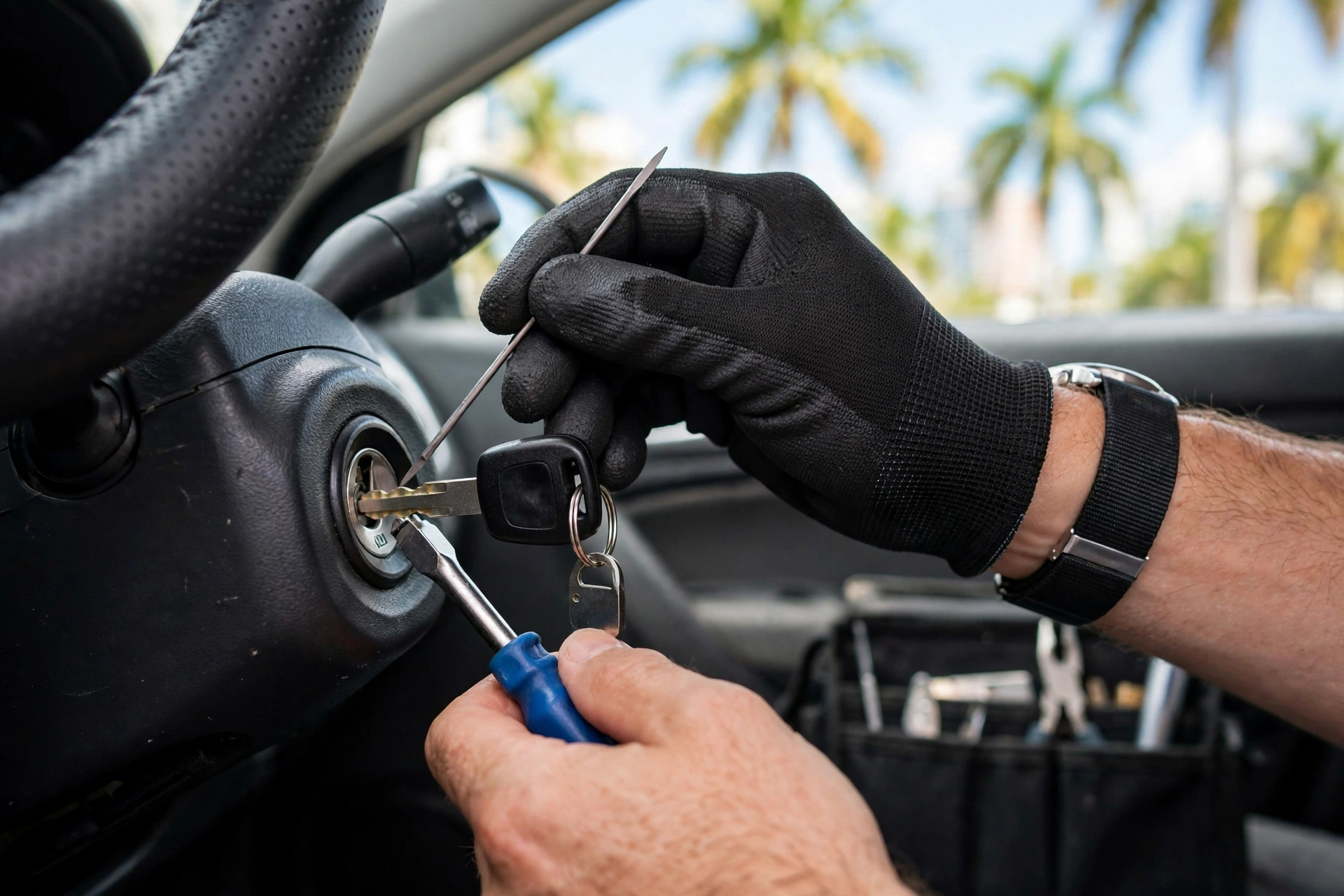
- The ignition lock cylinder. The mechanical part the key slides into. Inside it, wafers or tumblers read the cuts of your key; when the correct key is inserted, the cylinder can rotate.
- The ignition switch. The electrical part behind or attached to the cylinder. When the cylinder rotates, it moves the switch through its positions — accessories, on, start — powering the electronics and the starter.
On push-button cars there is no key cylinder to turn, but there is still an electronic start system with its own failure points. This guide focuses on keyed ignitions, which are the ones a locksmith repairs and replaces most often in Miami-Dade.
A third element matters on modern cars: the immobilizer antenna ring around the cylinder reads the transponder chip in your key. A mechanical repair that ignores the chip system can leave you with an ignition that turns but a car that will not start.
Signs your ignition cylinder is wearing out
- The key sticks or needs jiggling. You have to wiggle the key up, down or sideways to get it to turn — a classic sign of worn wafers or a worn key.
- The key is hard to insert or remove. It catches going in or hangs coming out at one specific point.
- The key turns but nothing happens. The cylinder rotates, yet no dash lights or no starter — that points more to the electrical switch or its contacts.
- The key spins freely or feels loose. Internal parts of the cylinder have failed; forcing it can lock the steering column.
- The key broke or almost broke in the ignition. A stiff cylinder is the most common reason keys snap.
- The problem comes and goes with temperature or humidity. Worn contacts and dirty wafers often fail first on hot Miami afternoons or after rain.
One important check before blaming the cylinder: try your spare key. A worn key produces exactly the same symptoms as a worn cylinder. If the spare turns smoothly, the problem is the key, not the ignition — a much simpler fix.
Repair or replacement: how the decision is made
Not every bad ignition needs a full replacement. The honest sequence is diagnosis first:
- Repair is often possible when the cylinder body and housing are sound and the wear is in the wafers. The cylinder can be removed, cleaned, fitted with new wafers matched to your key, and reinstalled — your existing keys keep working.
- Replacement is the better call when the cylinder housing is cracked or worn, internal parts have broken, a previous forced attempt damaged the unit, or the vehicle had a theft attempt. The new cylinder is then keyed to your existing key when the model allows it, or supplied with new keys that are cut and programmed.
- The electrical switch is replaced separately when the cylinder turns correctly but the electrical positions fail — no accessories, no dash, or the starter does not engage. On many models the switch is a separate part behind the cylinder and does not require changing your keys at all.
What you should expect from any quote: which part is failing — cylinder, switch, or key — and why. Replacing parts on assumption is how an ignition job gets expensive without getting fixed.
What happens to your keys and the immobilizer
- Keeping your key. When the cylinder is repaired or re-keyed to the original cuts, your current keys — including the transponder chips already programmed to the car — continue to work. No reprogramming is needed because the car still recognizes the same chips.
- If new keys are supplied, the blades are cut to the vehicle and the chips are programmed to the immobilizer, the same as any replacement transponder key. Old keys can be removed from the car’s memory when security requires it.
- Steering lock and airbag area. Ignition work happens at the steering column, close to the steering lock and, on many models, the airbag. It is not a place for force or guesswork; the column covers come off in a specific order and the battery is disconnected when the work requires it.
Why ignitions fail sooner in Miami
- Heat and humidity accelerate wear on electrical contacts inside the switch and corrosion on metal parts.
- Heavy keychains. A ring full of keys swings as you drive and slowly wears the cylinder from the inside — one of the most common and most preventable causes.
- A worn key used for years grinds the wafers out of tolerance a little more with every start.
- Dirt and sand. Beach sand and dust work their way into the keyway and act like sandpaper on the wafers.
A practical habit: keep the car key on a light ring of its own. It costs nothing and measurably extends the life of the ignition.
What not to do when the key won’t turn
- Do not force it. A key that will not turn with normal pressure will not turn with more pressure — it will break, and then extraction is added to the job.
- Do not spray oil or WD-40 into the ignition. Wet lubricants attract dirt and gum up wafers; ignition cylinders need dry lubricant or professional cleaning, not oil.
- Do not keep trying until the steering locks. Repeated forced attempts can engage the steering lock in a position that complicates the repair.
- Do not assume it is the battery. A dead battery gives you no dash lights and no crank, but the key still turns normally. If the key itself will not rotate, the problem is mechanical.
What to have ready when you call
- Make, model and year — they decide the cylinder type, the switch design and the parts available
- What the key does — won’t insert, won’t turn, turns with jiggling, or turns but the car won’t start
- Whether the spare key works — it separates a key problem from an ignition problem
- Whether dash lights come on — helps distinguish cylinder from switch from battery
- Your location — address or shared pin in Miami-Dade; ignition work is done where the car sits, no tow needed in most cases
- Proof of ownership — identification and ownership proof are reasonably required before ignition work or key programming
Service areas
Our mobile units cover Miami, Miami Beach, Doral, Kendall, Coral Gables, Brickell, Downtown, Wynwood, Hialeah, Aventura, Homestead and Miami Springs, and we serve drivers across South Florida.
Frequently asked questions
Can an ignition cylinder be repaired, or does it always need replacement?
Many cylinders can be repaired: the wafers are the wear item, and replacing them — matched to your key — restores smooth operation while your existing keys keep working. Replacement is needed when the housing or internal parts are damaged, or after a theft attempt. The condition of your cylinder decides, and we confirm it before recommending either route.
Will I need new keys if the ignition is replaced?
Not necessarily. A new cylinder can often be keyed to your existing key, so your current keys and their programmed chips keep working. If new keys are supplied instead, they are cut and programmed to the car as part of the job.
My key turns but the car won’t start. Is that the ignition?
It can be the electrical ignition switch — the part behind the cylinder — especially if dash lights or accessories also fail. It can also be the battery, the starter, or the immobilizer not recognizing the key. That is why diagnosis separates cylinder, switch, key and battery before any part is changed.
Can a locksmith do ignition work, or do I need the dealer or a mechanic?
An automotive locksmith handles the cylinder, the keys and the programming, and on many models the switch as well — at your location. A mechanic is the right call when the failure is deeper in the starting or electrical system beyond the ignition assembly. We tell you plainly when a job is not ours.
How long does ignition repair or replacement take?
It depends on the model: how the column covers come apart, whether the cylinder can be serviced in place, and whether keys need programming. We confirm scope, time and price before the work begins.
Key won’t turn? Get the ignition fixed where the car sits
If your key sticks, needs jiggling or will not turn in Miami, stop forcing it before the key breaks — and send us the make, model and year with a short description of what the key does. Matrix Locksmith Pro — ignition cylinder repair and replacement, key cutting and programming where your car is, anywhere in Miami-Dade.